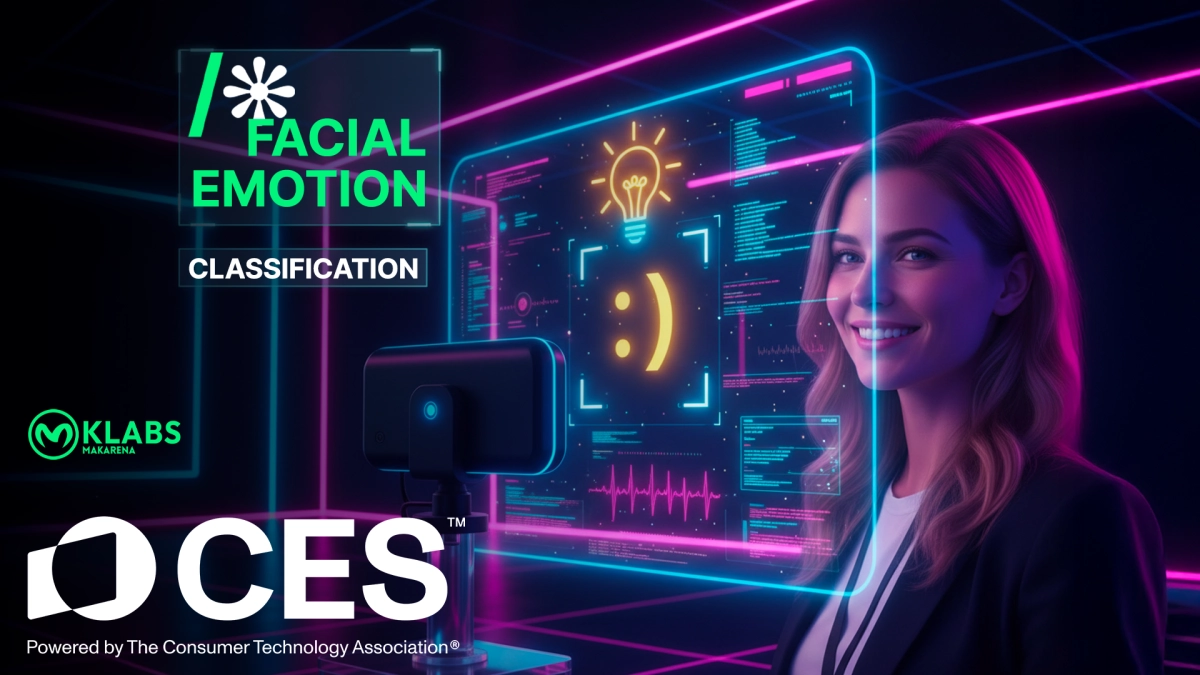
Why Emotion‑Aware Edge AI Matters for Modern Products
Today, every digital product competes on experience, responsiveness, and trust. When humans interact with robots, kiosks, medical devices, or smart city systems, their emotional state can be the difference between a positive outcome and a frustrated user.
Emotion‑aware edge AI allows systems to sense whether a person looks engaged, confused, or happy and respond immediately, without sending sensitive video data to the cloud. This is especially valuable in healthcare, public spaces, and industrial environments where privacy, latency, and safety are critical.
Who Is MakarenaLabs?
MakarenaLabs is an adaptive computing and AMD design partner focused on building advanced robots and AI‑powered products for smarter cities, safer healthcare, and brighter lives.
The company bridges academic research in embedded systems, hardware acceleration, and artificial intelligence with real‑world deployments, helping innovation teams turn complex R&D into market‑ready solutions
Inside the Facial Emotion Classification Demo with AMD Kria KR260
Our Facial Emotion Classification demo showcases how to implement real‑time emotion recognition at the edge using the AMD Kria KR260 Robotics Starter Kit.
-A standard USB camera captures live video of a user’s face.
-Frames are processed by the MuseBox SDK and a supervised emotion‑classification model running on PYNQ, categorizing each frame as angry, disgust, fear, happy, sad, surprise, or neutral.
-When a happy expression is detected, the system displays a smile icon on screen and activates a 5 V relay connected to the KR260 PMOD interface to turn on a light.
This simple yet powerful setup proves how facial emotion classification can drive immediate actions in the physical world while keeping computation and data at the edge device.
Key Benefits for Product and Engineering Teams
For enterprises, OEMs, and system integrators evaluating edge AI and robotics, the demo highlights four key benefits.
Real‑Time Facial Emotion Classification at the Edge
Running inference directly on the AMD Kria KR260 eliminates round‑trip latency to the cloud and reduces dependency on connectivity.
Sensitive video data stays on‑device, which supports stricter privacy and compliance requirements in sectors such as healthcare, public transport, and critical infrastructure
Seamless Integration with Physical Systems
The KR260 controls a relay that can drive lights, actuators, alarms, or other high‑voltage components, turning emotion detection into a direct trigger for real‑world actions. This makes it straightforward to embed emotion‑aware logic into robots, smart kiosks, industrial machines, or building‑automation systems without redesigning existing architectures.
Faster Path from Prototype to Product
Because the solution uses standard components – AMD Kria KR260, PYNQ, MuseBox, and a USB camera – teams can quickly build a proof of concept that mirrors production constraints.
Once the concept is validated, MakarenaLabs helps customers evolve the prototype into a robust, production‑grade design, including hardware acceleration, custom IP, and long‑term support.
High‑Value Use Cases for Emotion‑Aware Edge AI
Emotion recognition at the edge unlocks measurable value across multiple industries where MakarenaLabs is already active.
Smart cities and public mobilityInteractive totems, ticketing kiosks, and public information screens can adapt content or escalate to human support when users look confused or frustrated, improving citizen experience and service KPIs.
Healthcare and assisted livingMedical devices and monitoring systems can flag potential distress in patients or elderly users, helping caregivers intervene earlier and improving perceived quality of care.
Industrial robotics and cobotsRobots can adjust speed, distance, or behavior when operators appear stressed or uncomfortable, contributing to safer human–robot collaboration and reduced incident rates.
Retail and experiential marketingEmotion‑aware installations can reward engagement, for example by lighting up a product area when visitors smile, giving marketing teams a new metric for real‑world customer interaction.
Including these concrete scenarios in your content helps attract high‑intent visitors searching for terms like “edge AI for smart cities,” “emotion recognition in healthcare,” or “robotics safety with AI.”
Technology Stack: AMD Kria KR260, PYNQ, and MuseBox
The demo is built on a technology stack designed for edge‑AI performance and flexibility.
AMD Kria KR260 Robotics Starter Kit provides an FPGA‑based SOM optimized for robotics and computer vision workloads.
PYNQ offers a Python‑centric environment and Jupyter Notebook workflow, allowing developers to control the FPGA and iterate quickly on new ideas.
MuseBox delivers real‑time machine learning on FPGA, including pre‑built models for face detection, recognition, people tracking, and facial emotion classification.
This combination means engineering teams can move faster from idea to validated prototype while still meeting demanding performance, determinism, and reliability requirements.
Try the Facial Emotion Classification Demo (Non‑Commercial)
The Facial Emotion Classification demo for AMD Kria KR260 is available on GitHub for evaluation and non‑commercial use.
Clone the repository and follow the installation instructions to deploy the Jupyter Notebook on your KR260 board.
Connect a USB camera and the relay‑driven light to reproduce the full setup shown in our demo.
Experiment with custom behaviors, different actuators, or new UX flows to explore how emotion‑aware edge AI could work in your products.
Offering a hands‑on, non‑commercial demo is a proven way to attract highly qualified leads who are actively testing edge AI and robotics technologies.
How MakarenaLabs Helps Enterprises Turn Emotion‑Aware AI into Real Products
Most organizations need more than a demo – they need a trusted engineering partner to design, implement, and maintain production‑grade systems. MakarenaLabs works with enterprises, OEMs, and system integrators across the full lifecycle of AI‑driven robotics and edge‑computing projects.
Typical collaboration models include:
Technical discovery and feasibility studies tailored to your hardware, environment, and safety requirements
Architecture and hardware–software co‑design for edge AI, including FPGA acceleration and integration with existing robotics or IoT platforms
Custom model development and optimization for domain‑specific emotion recognition, computer vision, and behavior analysis
Long‑term support, monitoring, and evolution of deployed systems to keep performance, security, and compliance up to date
Positioning these services clearly in the article ensures that readers searching for “AI robotics development partner” or “AMD Kria design partner” immediately understand how MakarenaLabs can help.
Talk to Our Team About Your Emotion‑Aware Edge AI Roadmap
If you are evaluating facial emotion classification, AMD Kria KR260, or edge AI for robotics, smart cities, healthcare, or industrial systems, this is the right moment to explore what is possible with MakarenaLabs.
Contact us now to:
Book a technical discovery call about your specific use case
Request a guided walkthrough of the Facial Emotion Classification demo and the underlying architecture
Discuss a tailored proof of concept that connects emotion‑aware AI with your existing devices, platforms, and business goals